Can humans live on the moon is the central question driving decades of scientific research, engineering development, and programmatic planning. Scientists study the lunar environment to identify the physical and biological limits of human habitation. Engineers test habitats, life support, and resource extraction techniques in analog facilities on Earth and in orbital labs. Space agencies and private companies plan sequences of missions to reduce risk and build infrastructure that supports longer stays. This guide summarizes the main obstacles, the technologies and operational practices that can overcome them, and the realistic steps needed to make sustained lunar habitation possible in the coming decades.
Key Takeaways
- Human survival on the moon faces interlocking challenges: no breathable atmosphere, large temperature swings, low gravity, high radiation exposure, abrasive regolith, micrometeoroids, and logistical isolation.
- Closed-loop life support, in-situ resource utilization (ISRU) for water and propellant, and robust food-production systems are essential for long-term presence and for reducing dependence on Earth resupply.
- Radiation shielding strategies, including regolith-covered habitats, underground concepts, and engineered materials, are central to protecting health over multiyear stays.
- Habitat design must address thermal control, dust mitigation, modular expansion, maintenance by robotics, and redundancy in power, communications, and critical systems.
- Economic viability requires lower launch costs, reusable transport, local propellant and material production, legal frameworks for operations, and clear governance for safety and resource use.
- A phased timeline—robotic scouting and ISRU demonstrations, short-duration crewed sorties, polar habitat pilots, and gradual scale-up into longer-term settlements—offers a realistic pathway to answering whether can humans live on the moon sustainably.
The Moon’s Environment: Key Challenges To Human Survival
The moon presents a combination of harsh environmental factors that make human survival difficult without engineered protection. There is no breathable atmosphere and essentially no magnetic field, so solar ultraviolet, energetic protons from solar particle events, and galactic cosmic rays reach the surface unattenuated. Surface temperatures swing dramatically between lunar day and night, creating thermal stress for structures and materials. Lunar gravity is roughly one-sixth of Earth’s, changing locomotion, fluid behavior, and settling patterns for particles. The surface is blanketed with fine, electrostatically charged regolith that abrades seals, clogs mechanisms, and poses inhalation hazards. Micrometeoroid impacts, while individually small, are a persistent risk for exposed systems. Water is present mainly as ice in permanently shadowed polar craters and as bound volatiles in the regolith; these deposits are unevenly distributed and require targeted extraction technologies. Finally, early missions must rely primarily on supplies and expertise from Earth, which drives the need for modular, repairable, and highly reliable systems. Together, these factors form the baseline technical and operational challenge underlying the question: can humans live on the moon?
Life Support And Long‑Term Health: Air, Water, Food, Gravity Effects
Life support for lunar habitation combines atmospheric control, water management, food production, waste recycling, and medical care into highly integrated systems. Air systems must maintain breathable oxygen levels, remove carbon dioxide and trace contaminants, and control humidity; closed-loop approaches recycle oxygen from water electrolysis and recover breathable gas from waste processing to reduce resupply mass. Water management couples extraction of ice or hydrated minerals with purification, recycling of wastewater, and contingency stores. Food strategies blend frozen and prepackaged supplies for early missions with progressively larger indoor agriculture systems—hydroponics, aeroponics, or bioregenerative greenhouses—that provide fresh produce, psychological benefits, and partial nutrient regeneration. Low lunar gravity leads to bone demineralization, muscle atrophy, cardiovascular adjustments, and altered vestibular function; countermeasures under study include rigorous exercise protocols, resistance devices adapted for limited space, pharmacological approaches, and habitat designs that enable regular physical activity. Radiation exposure increases lifetime cancer risk and can affect cognitive function; effective protection plans include habitat shielding, operational limits on extravehicular activity, early-warning space weather forecasting, storm shelters, and medical surveillance. Psychological health is equally important: isolation, confinement, and distance from Earth require crew selection, robust communication schedules, private living spaces, recreational facilities, and social protocols to sustain team cohesion. All systems must be sized with redundancy and maintainability in mind, because continuous, reliable operation is the practical determinant of whether can humans live on the moon for months and years at a time.
Habitats And Technologies That Make Living Possible
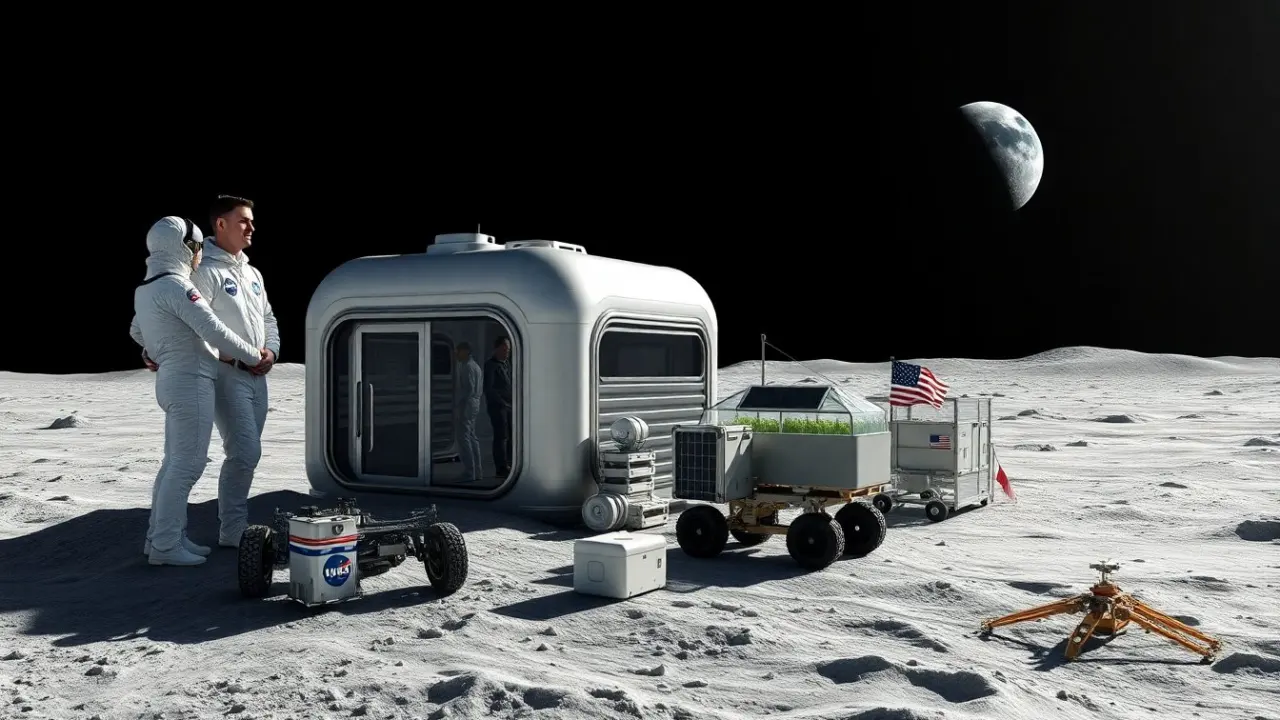
Habitat concepts range from landed modules and inflatable structures to subsurface caverns and regolith-covered shelters. Designers focus on layers of protection: pressure-retaining shells for vacuum, multilayer insulation and active thermal control against temperature swings, and mass or engineered materials for radiation shielding. Covering habitats with regolith or situating them in lava tubes can dramatically reduce radiation and micrometeoroid risk, and automated regolith-moving equipment is a likely early capability. Robotics will play a central role in site preparation, assembly, inspection, and routine maintenance before and after crew arrival, reducing risk and enabling incremental expansion. Power architectures will combine high-efficiency solar arrays—particularly at polar sites with extended sunlight—energy storage systems sized to survive lunar night or shadowed operations, and potentially small fission reactors for continuous baseload power. Communications and navigation networks must provide resilient links to Earth and to surface assets, supporting telemedicine, remote operations, and scientific data return. Manufacturing and construction technologies, including additive manufacturing using lunar regolith and in-situ fabrication of spare parts, will reduce dependence on Earth-supplied hardware. Propellant production from water electrolysis and ISRU-derived oxygen will lower round-trip logistic costs and enable refueling for cargo and crew transport. Together, these technologies determine practical answers to can humans live on the moon by making habitats safe, sustainable, and adaptable.
Logistics, Economics And Governance Of A Lunar Settlement
Lunar logistics coordinate transportation, staging, supply chains, and on-site resource distribution. Transport economics hinge on launch cost reductions, vehicle reusability, and the maturity of rendezvous and landing systems. Early government-led missions will focus on safety, science return, and technology demonstration, while private companies aim to provide cargo delivery, habitat modules, and commercial services that can scale with demand. Economic models for sustained presence depend on a mix of public investment, commercial revenue streams (science, tourism, manufacturing, propellant sales), and development of local industry using lunar materials. Legal and governance questions—how to allocate resources, ensure safety, mediate disputes, and provide emergency response—require international agreements and clear operational norms. Issues such as search and rescue, medical evacuation protocols, liability, export controls, and standards for environmental protection of scientific sites will influence investor confidence. Insurance models, supply-chain resilience, and a workforce pipeline for lunar operations are practical considerations that affect whether large-scale habitation is affordable and politically sustainable. Effective governance, combined with predictable logistics and commercial opportunities, will determine whether can humans live on the moon not just as temporary visitors but as a functioning, resilient community.
Realistic Timeline And Next Steps Toward Sustainable Habitation
A practical timeline toward sustainable lunar habitation follows phased milestones rather than single events. Near-term activities include robotic prospecting, ISRU pilot demonstrations, and short crewed sorties that validate landing systems, habitats, and surface operations. Demonstration missions in the coming years will test life support loops, dust mitigation, and extravehicular systems at relevant scales. Mid-term priorities are emplacement of semi-permanent polar habitats with integrated power and ISRU pilots, expanded in-situ manufacturing capability, and longer-duration crew rotations that allow study of cumulative health effects. Private-sector initiatives will aim to establish regular cargo routes and service platforms that lower per-mission cost. Long-term steps focus on scaling local industry—propellant and material production, automated manufacturing, and surface construction—to support a continuously inhabited base with growing scientific and commercial activity. Throughout this progression, measurable milestones—successful ISRU extraction campaigns, validated closed-loop life support over months, demonstrated radiation protection strategies, and reliable transport and logistics chains—will collectively answer whether can humans live on the moon sustainably. International collaboration, sustained funding, iterative testing, and transparent sharing of lessons learned are the practical enablers that will shape the pace and extent of lunar settlement.