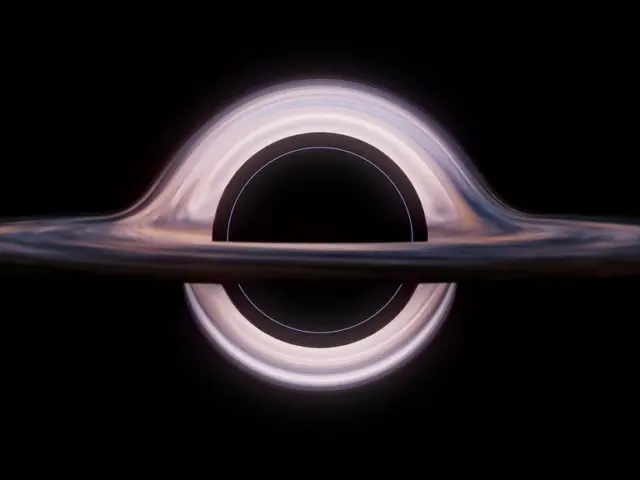
Scientists ask: what is inside a black hole? The question drives theory and observation. Relativity gives one answer. Quantum theory gives a different answer. Astronomers test predictions with indirect data. This guide states main models, evidence, and next steps in clear terms.
Key Takeaways
- General relativity predicts black holes have a singularity and event horizon where gravity traps everything, but it cannot describe interior details at quantum scales.
- Quantum theory introduces Hawking radiation, suggesting black holes can evaporate and raising questions about how information escapes or is preserved inside.
- Leading quantum models like firewalls, fuzzballs, and Planck-scale cores propose different inner structures that challenge the classical black hole picture.
- Indirect observations—such as gravitational waves, horizon-scale imaging, and accretion disk signals—help test and refine theories about black hole interiors.
- Future telescopes and detectors promise sharper data to distinguish among competing models and deepen our understanding of what is inside a black hole.
What General Relativity Predicts About The Interior
General relativity predicts a simple interior for black holes. It treats gravity as spacetime curvature. Mass compresses spacetime and creates a region from which light cannot escape. For a nonrotating black hole, relativity gives the Schwarzschild solution. The solution shows an event horizon and a singularity at the center. The event horizon forms a one-way boundary. The singularity is a point where curvature and density diverge. Classical equations break at that point. They stop giving physical predictions there. Relativity predicts that any object that crosses the horizon cannot return. Observers outside detect only external effects: gravitational redshift and time dilation. Inside the horizon, all future-directed paths lead to the singularity. The theory implies infinite tidal forces at that point for most black holes. For rotating or charged black holes, relativity gives more complex interiors. It predicts inner horizons and regions with closed timelike curves. These features raise stability problems in the equations. Physicists call these features mathematical rather than physically tested. Relativity does not include quantum effects. It so cannot describe what happens at scales near the Planck length. That gap leaves the question “what is inside a black hole” open in practice. Observers so treat the relativistic interior as a useful but incomplete model.
How Quantum Theory And Quantum Gravity Change The Picture
Quantum theory modifies the classical picture. It forces energy, information, and causality into the analysis. Quantum fields on curved spacetime show that black holes radiate. This result gives the famous Hawking radiation. Hawking radiation implies that black holes lose mass and may evaporate over time. That process raises the information paradox: does information that falls in return in the radiation or vanish? Quantum gravity attempts to answer that question. The field proposes new interior structures at scales near the Planck length. These structures replace the classical singularity. They also change how the horizon behaves and how information flows. Physicists propose several main quantum models that address these issues below.
Leading Quantum Models: Firewalls, Fuzzballs, And Planck-Scale Cores
Firewalls propose that an energetic barrier forms near the event horizon. The barrier breaks entanglement and returns information in outgoing radiation. The firewall picture changes the safety of horizon crossing. It predicts that infalling observers encounter high-energy quanta at the horizon. Fuzzballs arise from string theory. They replace the black hole interior with a many-state configuration of strings and branes. In fuzzballs, no singular point exists: instead, microstates fill the region where the horizon would stand. The model gives a mechanism for information to escape via subtle differences between microstates. Planck-scale cores propose that quantum gravity creates a dense core with finite size. The core has extreme density but not infinite curvature. This option preserves a smooth horizon for many practical cases while avoiding singularities. Each model treats the question “what is inside a black hole” differently. Some models force radical changes at the horizon. Others confine new physics to the central region. None of the models yet offers a complete, empirically verified description. Researchers compare model predictions to known physics and to possible observational signatures. They also test internal consistency and compatibility with thermodynamics.
Observations, Indirect Evidence, And Future Experiments To Probe Interiors
Direct probes of black hole interiors remain impossible because light cannot escape from inside the horizon. Observers rely on indirect measurements instead. They study motion of nearby stars, gas accretion, gravitational waves, and radiation near the horizon. The Event Horizon Telescope produced images that constrain horizon-scale structure. LIGO and Virgo detect gravitational waves from black hole mergers. Analysis of those waves can reveal deviations from general relativity during ringdown. Scientists search those deviations to test models that answer what is inside a black hole. Astronomers monitor quasi-periodic oscillations and X-ray spectra from inner accretion flows. Those signals carry information about strong gravity near the horizon. Future detectors will improve sensitivity. Next-generation very-long-baseline arrays will sharpen horizon-scale imaging. Third-generation gravitational-wave observatories will track finer ringdown details. Proposed space-based detectors will access lower-frequency signals from massive binaries. These observatories can test for echoes in post-merger signals. Echoes could indicate reflective structure near the horizon. They can also bound the size of any Planck-scale core. Laboratory experiments on analogue systems provide additional insight. Scientists create acoustic and optical analogues that mimic horizon behavior. These analogues let teams test aspects of Hawking-like emission and information flow. None of these experiments can yet resolve the interior definitively. But combined results can rule out classes of models. The field moves forward by tightening observational bounds while refining theoretical predictions about what is inside a black hole.