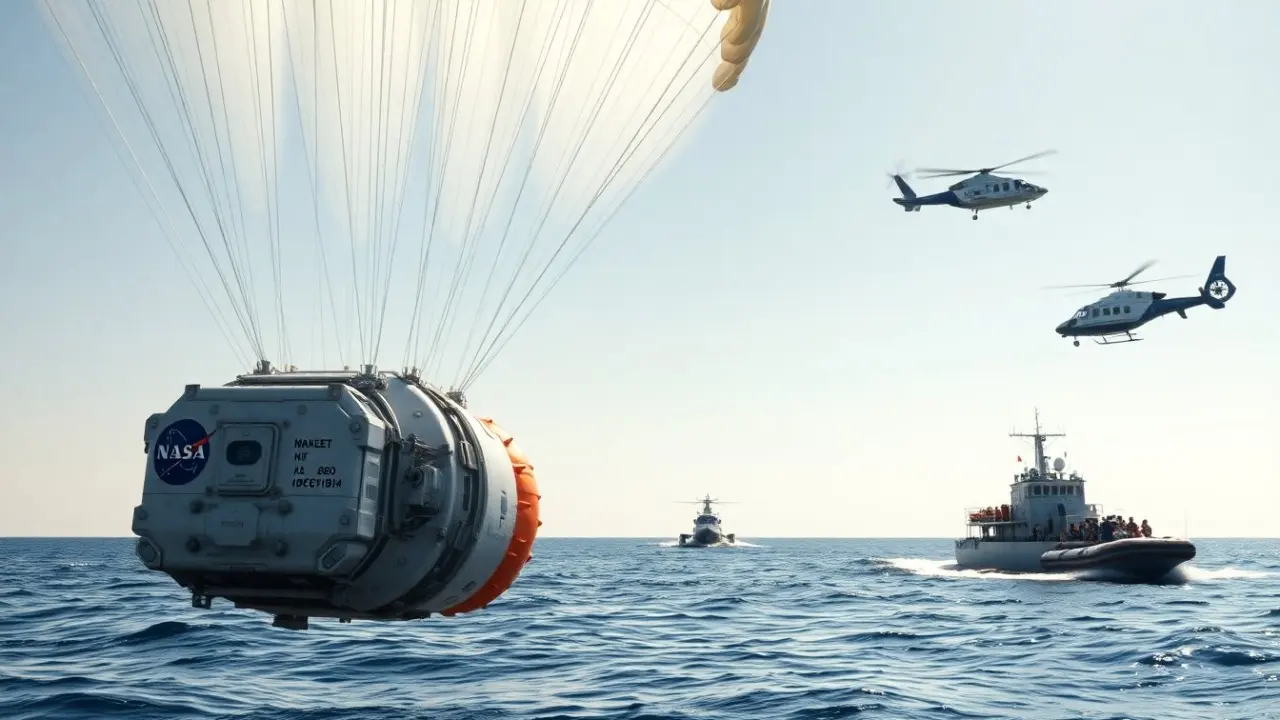
how do astronauts return to earth is a common question. The article explains the full process from orbit to ground. It covers crew prep, deorbit burns, reentry heating, parachutes, and recovery. The writing keeps steps clear and factual. Readers will learn what happens and why each step matters, including the roles of spacecraft hardware, onboard software, ground control, and recovery teams at every phase of descent.
Key Takeaways
- Astronauts return to Earth by performing a deorbit burn that slows their spacecraft and directs it into the atmosphere for reentry.
- Heat shields protect the capsule and crew from intense heating during atmospheric reentry while attitude control manages deceleration safely.
- Parachutes deploy in stages—drogue then main canopies—to slow the capsule for a controlled landing either by ocean splashdown or runway touch down.
- Ground and recovery teams prepare extensively to monitor descent, secure the landing site, and assist astronauts immediately after touchdown.
- Redundant systems, abort modes, and pre-flight checks reduce risk; every phase has checkpoints to confirm systems are within limits.
- Post-landing, astronauts undergo medical checks and rehabilitation to ensure their health after enduring high g-forces and reentry stresses.
- The entire process of how astronauts return to Earth involves careful planning, simulation, and coordination across engineering, medical, and operations teams.
How Reentry Works: The Big Picture
Reentry begins when mission control and the onboard flight computer agree it is time to end the orbit. The vehicle performs specific maneuvers to lower its perigee so that the atmosphere intercepts the capsule on a planned path. The overall objective is to convert orbital kinetic energy into thermal energy and aerodynamic drag in a controlled way so the capsule slows without skipping out or burning up. Designers define a safe “reentry corridor” — a narrow range of angles and velocities that keep deceleration and heating within the limits of the heat shield and structure. Throughout this sequence, navigation systems update position and velocity, telemetry streams to ground teams, and recovery forces move into position at the predicted landing zone. Understanding these system-level interactions helps answer how do astronauts return to earth from a systems and operational perspective.
Preparing The Crew And Capsule For Descent
Preparation begins hours to days before reentry. Engineers run diagnostics and close out any remaining checklists: propellant margins, battery health, communication links, and parachute pack inspections. Technicians verify that explosive bolts, hinges, and deployment mechanisms are armed according to procedure. Flight surgeons perform medical assessments to confirm each astronaut is fit for the G-loads and stresses of descent; this can include quick functional checks and review of recent health telemetry. The crew secures loose items, configures seats and harnesses, and rehearses failure modes — for example, what to do if one parachute fails to inflate. Mission control uploads the reentry timeline and any updated landing-site information; the crew acknowledges each step. These combined actions reduce the chance of surprises during the critical phases of how do astronauts return to earth in practice.
The Deorbit Burn: Changing Trajectory Back Toward Earth
The deorbit burn is the first propulsive act that intentionally removes orbital energy. It is typically a retrograde firing — opposite the direction of travel — that lowers the spacecraft’s perigee into the upper atmosphere. The burn duration and thrust profile are calculated to place the vehicle on the correct reentry corridor and to set the landing ellipse downrange. Guidance, navigation, and control systems monitor engine performance, propellant consumption, and attitude during the burn. Crews watch instrumentation and are prepared to initiate abort sequences if parameters deviate beyond safe margins. After the burn, the spacecraft coasts on the new trajectory as ground and onboard systems continue to refine reentry timing and predict touchdown location, providing the operational context for how do astronauts return to earth from a precise orbital solution.
Atmospheric Reentry: Heat, G-Forces, And Attitude Control
When the capsule begins to encounter the upper atmosphere it faces extreme heating caused by compression and friction with air molecules. Modern heat shields are designed to absorb, conduct, or ablate that energy away from the pressure vessel. The vehicle also endures high deceleration forces; peak g-forces depend on the entry angle, speed, and vehicle shape. To control both heating and deceleration, the capsule uses attitude control — often by moving reaction control thrusters, shifting mass, or using a center-of-gravity offset — to maintain a stable angle of attack. Aerodynamic stability prevents unwanted oscillations or tumbling that would increase heating or jeopardize crew safety. Onboard sensors continually sample temperature, pressure, and acceleration; flight software uses those inputs to manage control surfaces or thrusters and to trigger downstream events such as parachute deployment. The crew follows procedures to protect themselves from g-forces, using body position, harness restraint, and breathing techniques while the vehicle completes this high-energy phase that is central to how do astronauts return to earth.
Canopies, Drogues, And Parachutes: Slowing For Landing
After the vehicle has passed the peak heating phase and slowed sufficiently, a staged parachute sequence transitions the spacecraft from a high-speed entry to a slow, controlled descent. Small stabilization chutes or drogues are often deployed first to arrest tumbling and orient the capsule. Drogues reduce speed to a range where the main canopy or canopies can be safely deployed. On larger capsules, pilot chutes extract the mains, which then inflate and carry the descent load. Parachute systems contain sensors, barometric altimeters, and timers to ensure deployment at the correct altitude and airspeed; many designs include redundancy such as multiple parallel canopies so that the system tolerates a partial failure. For precision landings — such as runway-style recoveries — supplementary systems like parafoils or lifting-body aerodynamics help steer and flare for touchdown. Inspection of parachute components after recovery informs maintenance and future packing procedures, forming a feedback loop in how do astronauts return to earth reliably.
Touchdown Options: Ocean Splashdown Versus Runway Landing
Crewed missions typically choose a touchdown method based on spacecraft design, mission constraints, and recovery logistics. Traditional capsules—spherical or bell-shaped—are optimized for water landings: their shape provides a predictable attitude under parachutes and buoyant structures or flotation collars keep the capsule upright after splashdown. Naval assets—ships, helicopters, and recovery divers—secure the crew and recover critical hardware. Other spacecraft, including lifting-body capsules or winged vehicles, are engineered for runway landings. These require landing gear, more complex approach control, and airfield support. Runway recoveries allow faster transfer to medical facilities and detailed inspections but demand tight cross-range capability and favorable weather. Both approaches depend on accurate trajectory targeting, weather monitoring, and contingency plans; comparing them helps explain practical choices in how do astronauts return to earth for different missions.
Post-Landing Recovery And Medical Checks
Once the vehicle is secured, recovery teams prioritize crew egress and immediate medical assessment. Medics perform quick checks for consciousness, breathing, circulation, and any acute injuries. Because reentry exposes astronauts to varied stresses—orthostatic intolerance, muscle deconditioning, and sometimes transient vestibular symptoms—medical teams monitor blood pressure, heart rate, and motion-sickness indicators, and provide fluids or medications as needed. Engineers and technicians inspect the spacecraft, retrieve flight data recorders, and begin post-flight analysis to understand system performance. Crews are debriefed on anomalies, timeline deviations, and subjective impressions. In the hours and days that follow, astronauts undergo more comprehensive medical exams and rehabilitative care to readapt to Earth gravity. These coordinated steps complete the operational cycle of how do astronauts return to earth and ensure lessons learned feed into the planning of future missions.