How does gravity work explains why objects fall and why planets orbit. The question guides experiments and math. Scientists describe gravity with clear rules and equations. They test those rules with clocks, lasers, and satellites. This article gives a simple account of the main ideas. It shows how the concept connects to motion, time, and everyday effects.
Key Takeaways
- Gravity is a force that pulls masses toward each other, explained simply by Newton’s law linking force, mass, and distance.
- Einstein transformed our understanding of gravity as the curvature of space-time caused by mass and energy, changing how objects move.
- Newton’s gravity theory works well for most everyday problems, but Einstein’s theory is essential for understanding extreme conditions like black holes and high-speed spacecraft.
- Gravity affects both space and time, which scientists measure through experiments involving clocks, satellites, and light.
- The gravitational pull explains phenomena such as orbits, tides, and weightlessness in space, influencing natural events and technologies on Earth.
- Modern tools like atomic clocks and laser interferometers allow precise testing of gravity, confirming theories and enhancing applications in navigation and physics.
What Gravity Is — Fundamental Concepts And Intuition
Gravity is a force that pulls mass toward mass. People feel gravity as weight when they stand on the ground. Isaac Newton framed gravity as a pull that acts at a distance. Newton gave an equation that links force, mass, and distance. Scientists still use Newton’s law for many practical problems because it gives correct numbers for everyday scales. The law states that force equals a constant times the product of two masses divided by the square of their separation.
Modern readers often ask how gravity works at a deeper level. Albert Einstein reframed gravity as a feature of space and time. He said mass and energy change the shape of space-time. Objects move along paths that follow that shape. In that view, gravity is not a force in the old sense but an effect of curved geometry.
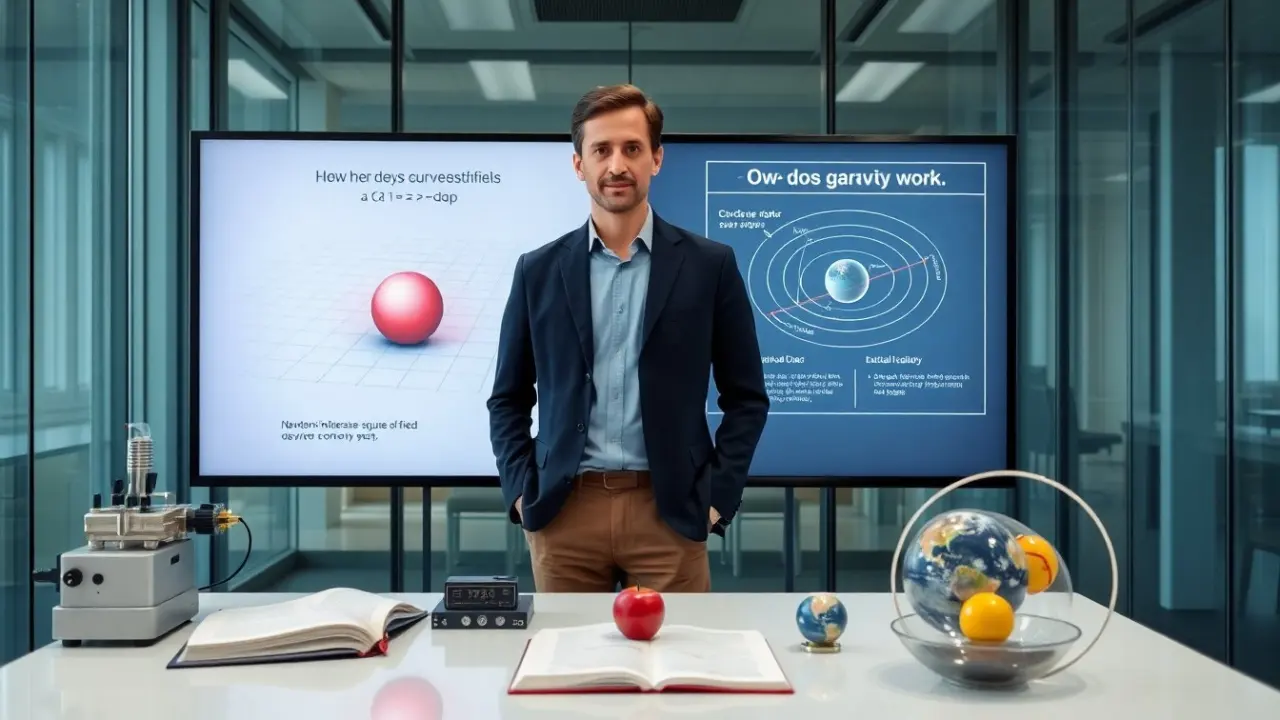
People can form simple intuition by imagining a stretched sheet and a heavy ball that makes a dip. Smaller balls roll toward the dip. The image helps explain why planets orbit stars and why apples fall toward Earth. The image does not show details about light or time. Still, the image gives the right basic picture: matter tells space-time how to curve, and curved space-time tells matter how to move.
Scientists measure gravity by timing falling bodies, tracking orbital paths, and reading small shifts in clocks. Instruments show that gravity affects time as well as distance. This link between space, time, and mass gives gravity its broad reach across scales, from falling apples to galaxy motion.
Newton To Einstein — The Two Theories That Explain Gravity
Newton offered a clear formula that predicts how bodies attract each other. People use that formula to compute trajectories for rockets and satellites. The formula works when speeds stay much below the speed of light and when gravity stays weak. Engineers and navigators rely on Newtonian gravity for most tasks around Earth.
Einstein replaced Newton’s force picture with a geometric picture. He wrote equations that link energy and mass to the curvature of space-time. The equations predict light bending near mass, shifts in clock rates, and the perihelion advance of Mercury. Observers confirmed those effects with solar eclipse measurements and with modern radio and laser tests.
Scientists use Einstein’s theory when they study black holes, merging neutron stars, and the behavior of clocks on high-speed spacecraft. The theory gives accurate predictions for the Global Navigation Satellite System when scientists add relativistic corrections. People adjust satellite clocks because gravity and motion change the tick rate.
Both theories have limits. Newton’s law fails where gravity gets very strong or where time effects matter. Einstein’s equations stay accurate in those cases, but they leave one question open: how gravity behaves at the smallest scales where quantum effects matter. Researchers now build experiments and mathematical models that aim to unite Einstein’s gravity with quantum theory. They test ideas with particle accelerators, tabletop devices, and astronomical observations.
Readers should note that the two views produce the same numbers in many cases. Scientists choose the simpler model that gives correct results for the problem at hand.
Gravity In Action — Orbits, Tides, Weightlessness, And Practical Effects
Gravity keeps the Moon in orbit around Earth and Earth in orbit around the Sun. The pull between bodies creates centripetal acceleration that sustains orbital motion. People observe stable orbits when gravitational pull balances inertial motion. Mission designers use this balance to place satellites on precise paths.
Tides arise because gravity changes with distance. The side of Earth facing the Moon feels a slightly stronger pull than the far side. Water shifts because of that difference, and tides follow as a result. Tides affect navigation, coastal ecosystems, and some forms of energy generation.
Weightlessness occurs when objects fall together with the same acceleration. Astronauts feel weightless in orbit because their spacecraft and their bodies fall around Earth at the same rate. The sensation does not mean the absence of gravity. Gravity in low Earth orbit is only slightly weaker than at the surface.
Gravity also shapes practical technology. Designers use gravity to route water, to stabilize structures, and to size foundations. Engineers compute load and stress with gravitational force applied to mass. Surveyors measure local gravity to infer subsurface features in mining and oil work.
Recent tools let scientists test gravity with high precision. Atomic clocks measure tiny shifts in time caused by height changes. Laser interferometers detect minute stretching of space during gravitational waves. These tools confirm predictions and find new phenomena. They guide improvements in navigation, Earth observation, and tests of fundamental physics.
Readers should remember that gravity acts universally on mass and energy. That universality gives gravity its power to organize motion from falling objects to galaxy clusters. It also makes gravity a central subject in ongoing scientific study.