How far is Mars from the Earth depends on the date: across oppositions, NASA gives approaches ranging between 35 and 63 million miles. Radio signals need minutes to cross that gap, so distance shapes both launches and communication.
This guide explains the orbital mechanics behind that range, then turns the figures into practical limits for travel and settlement. For the hardware side of the same problem, see the technology needed for a mars base.
Why the distance changes
The Mars–Earth distance changes because the two planets orbit the Sun at different speeds, on paths of different shapes. Each of those two effects does separate work, and the distance you see on any date combines them.
Different orbital periods and the repeating cycle
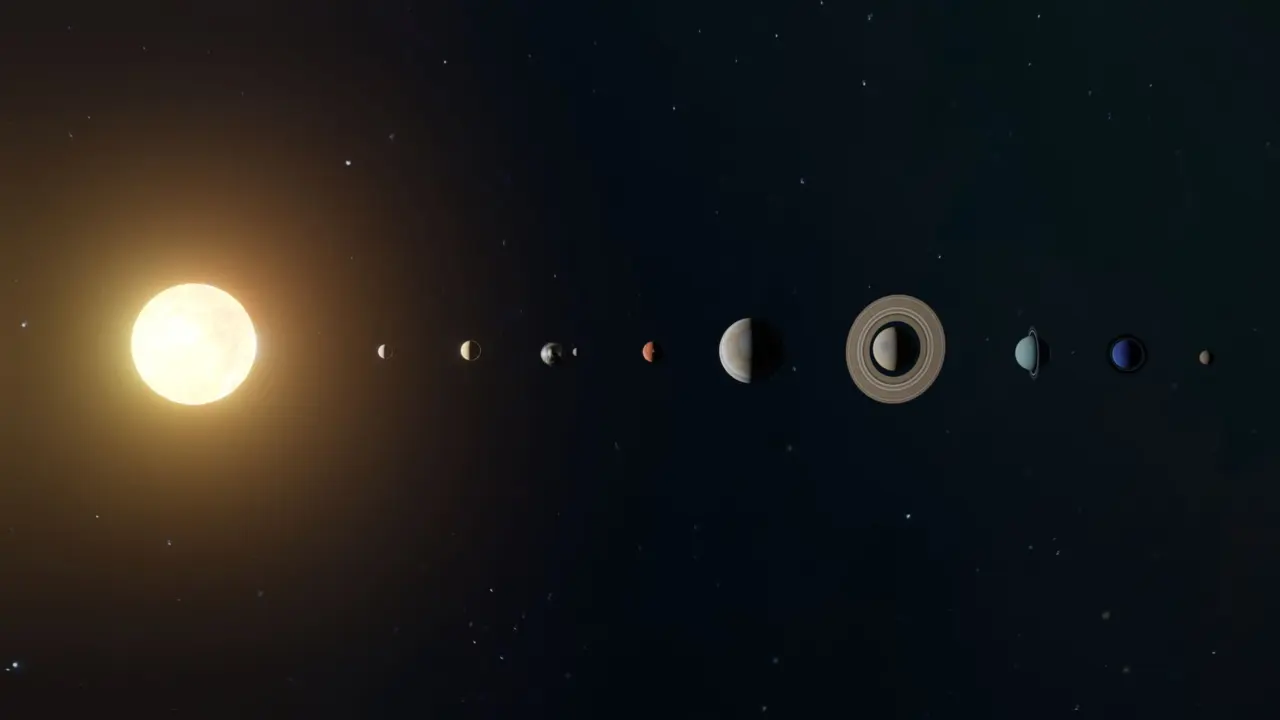
NASA notes that Mars takes 687 Earth days to make its trip around the Sun, while Earth takes 365 days. Earth therefore laps Mars. Roughly every 2 years, Earth’s orbit catches up to Mars’s orbit, which produces a Martian opposition every 26 months. That repeat interval between oppositions is the synodic period of the Earth–Mars pair.
At opposition, Earth lies on a straight line between Mars and the Sun, as EarthSky describes it. That alignment is the favourable end of the cycle for short distances. Away from opposition the planets drift apart, and the table-style figures below describe only the near end of that swing.
An elliptical orbit that moves the target
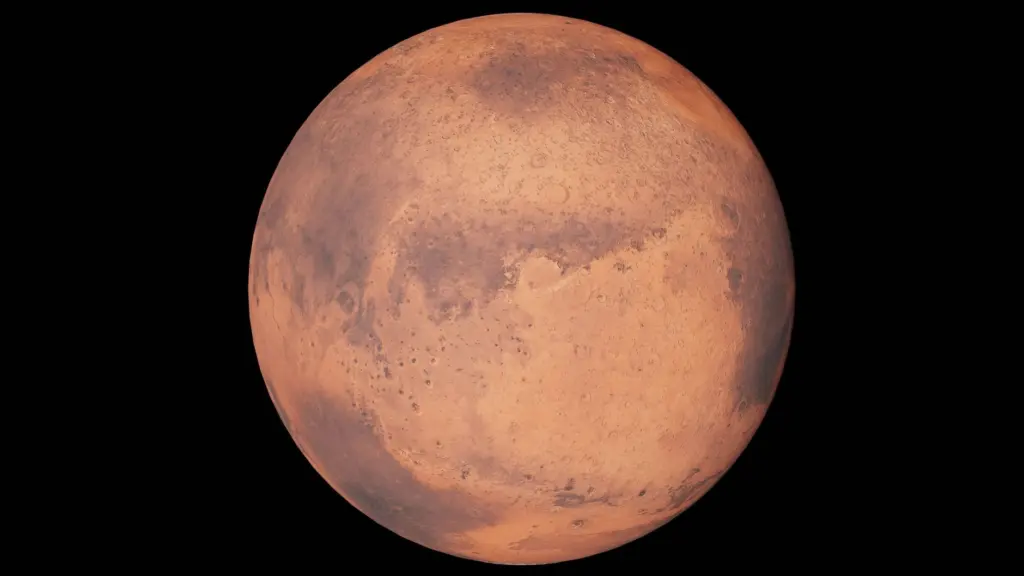
Orbit shape explains why one opposition is not the same as the next. NASA points out that while Earth is on a very near-circular orbit, Mars sweeps out a large ellipse. When an opposition happens with Mars near its closest point to the Sun, the planets pass much nearer than when Mars is on a more distant part of its path. In 2003, Earth was near aphelion while Mars was at perihelion, and the result was a historic approach.
This is why a single “Mars distance” cannot be quoted without a date. The 2-year rhythm is steady, but the gap it delivers varies from cycle to cycle.
Opposition is not always the closest day
Opposition and closest approach are related but separate events. In the 2025 cycle, the closest approach fell on January 12, while opposition came on January 15-16. For planning, treat opposition as the centre of a period of favourable distances and use the closest-approach date when you need the minimum gap.
Closest, farthest and typical distances
Across recent and upcoming oppositions, the Earth–Mars gap runs from about 35 million miles at the near extreme to about 63 million miles at the far extreme of the century’s oppositions. The table compares approaches that bracket that range.
| Close approach | Distance | Planning use |
|---|---|---|
| August 27, 2003 | 34.65 million miles (55.76 million km) | The nearest approach listed; the shortest crossing and the least propellant demand of these examples. |
| July 2018 | 35.78 million miles (57.59 million km) | Also at the near end, so a useful benchmark for a favourable year. |
| December 2022 | 50.61 million miles (81.45 million km) | A middle case: clearly farther than 2018, well short of the far extreme. |
| January 12, 2025 | 59.70 million miles (96.08 million km), or 0.642 AU | A distant approach; the light delay at this distance is 5.3 light-minutes. |
| February 20, 2027 | 63.01 million miles (101.41 million km) | The most distant opposition of the 21st century; the least favourable year to plan around. |
| March 29, 2029 | 60.42 million miles (97.24 million km) | Still far, so do not expect an easy year just because it follows 2027. |
These distances come from EarthSky’s list of Mars close approaches.
NASA described the 2003 encounter as the closest in nearly 60,000 years, giving the separation as 34.7 million miles (55.8 million km). The small difference from the table is rounding between sources, not a different event.
Read the table as a spread, not an average. Mars does not sit at a typical distance; it swings through the cycle, and the oppositions listed are only the close end of that swing. When someone asks how far Mars is today, the honest answer is a figure tied to a specific date from an almanac or ephemeris, not a rule of thumb.
Signal delay to Mars
Radio signals travel at light speed, so the delay to Mars equals the distance expressed in light-time. At the January 12, 2025 approach, Mars was 5.3 light-minutes away at a distance of 0.642 astronomical units.
That figure is useful as an anchor, but it is not a ceiling or a typical value. Because delay scales with distance, an approach such as 2003 would carry a shorter delay, and the stretches of the cycle away from opposition carry a longer one. Plan around the worst part of the cycle, not the best.
Three practical consequences follow for a crew or a settlement:
- No live conversation. A question sent from Mars and its answer from Earth must both make the trip, so exchanges happen as messages, not as a call.
- Commands in batches. Controllers on Earth cannot steer routine work in real time, so tasks need to be specified in advance and checked afterward.
- Local decision-making. Anything urgent, such as a pressure alarm or a medical problem, has to be handled by people on the surface, using procedures and equipment they already have.
Launch windows and travel time
The distance sets launch opportunities mainly through fuel. NASA states that with a shorter distance to traverse, not as much fuel is needed to boost the mission to Mars. Since opposition recurs about every 2 years, favourable opportunities recur on the same rhythm, and a mission that misses one waits for the next.
Not every opportunity is equal. The approach dates in the table show that February 2027 and March 2029 are both farther than December 2022, and 2027 is the most distant opposition of the century. By the fuel logic above, a mission planned around those years faces a less forgiving geometry than one planned around a close approach like 2018.
Be careful with transit time. The straight-line gap on one date is not the path a spacecraft flies, so for the duration of a trip rely on a specific mission’s published plan instead of converting a distance figure into days.
What the changing distance means for settlement
The cycle turns Mars into a destination with a calendar. Supplies, replacement parts and people can move on the favourable stretch of each 26-month rhythm, and in between a settlement has to live on what it has. That argues for stocking consumables and spares to cover a full gap between opportunities, not to cover the next expected delivery, and for treating a distant opposition year as a planning risk rather than a rounding detail.
Communication works the same way. A delay that is measured in minutes even at a close approach means support from Earth is advisory, not operational. Systems from habitat life support to mars spacesuit technology need to be repairable and understandable by the people wearing and maintaining them. Even everyday systems matter on long journeys; How Astronauts Go to the Bathroom in Space: What You Need To Know In 2026 – Decolonizemars shows how much routine crew life depends on hardware that has to keep working far from help.
The practical rule is simple. Quote any Mars distance with a date, plan communications for the longest delay in the cycle, and treat each close approach as a limited opportunity rather than a permanent condition.
Frequently asked questions
Can I give one number for the Mars–Earth distance?
No. The distance depends on the date, and across oppositions NASA reports approaches between 35 and 63 million miles. Quote a figure together with its date.
Do opposition and closest approach happen on the same day?
Not always. EarthSky notes the gap between them can be as long as 8.5 days (1969), or as little as 10 minutes (2208 and 2232).
Which approach is the most distant this century?
The February 20, 2027 approach, at 63.01 million miles (101.41 million km), is the most distant opposition of the 21st century.