How far is Mars from the Sun in AU? The average distance is about 1.52 AU. This article gives clear facts. It explains the AU unit. It shows Mars’ closest and farthest points. It shows how scientists measure distance. It gives quick conversions to kilometers and light minutes. It shows why the distance matters for missions and science.
Key Takeaways
- Mars is about 1.52 AU away from the Sun on average, meaning it is roughly one and a half times the Earth-Sun distance.
- An astronomical unit (AU) equals 149,597,870.7 kilometers and provides a simple scale to compare planetary distances.
- Mars’ distance from the Sun varies between 1.381 AU at perihelion and 1.666 AU at aphelion, influencing its climate and seasons.
- Scientists measure Mars’ distance using radar, spacecraft tracking, and optical methods, converting these into precise AU values.
- Understanding Mars’ distance in AU helps engineers and mission planners design spacecraft and schedule launches efficiently.
- The AU measurement aids in explaining Mars mission timelines and scientific concepts in an accessible way.
What Is an Astronomical Unit (AU)?
An astronomical unit (AU) measures distance in the solar system. Astronomers set one AU as the mean distance from Earth to the Sun. Scientists define one AU as 149,597,870.7 kilometers. The AU gives an intuitive scale for planetary orbits. The AU simplifies comparisons between planets. The AU helps planners estimate travel time and fuel for probes. The AU helps publishers report distances without long numbers. The AU links orbital data to mission planning and public communication.
Mars’ Average Distance From the Sun in AU
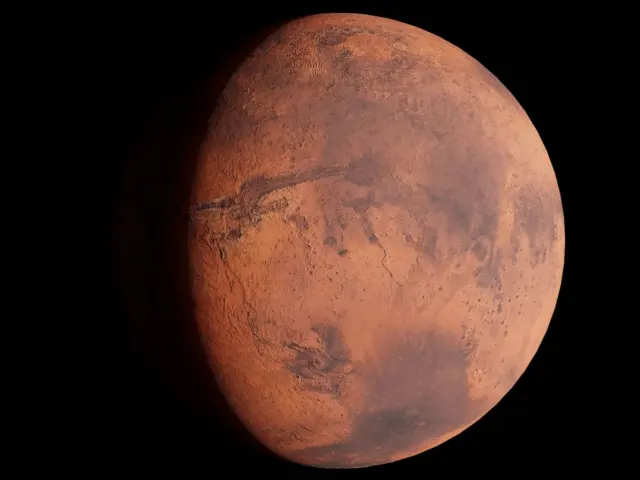
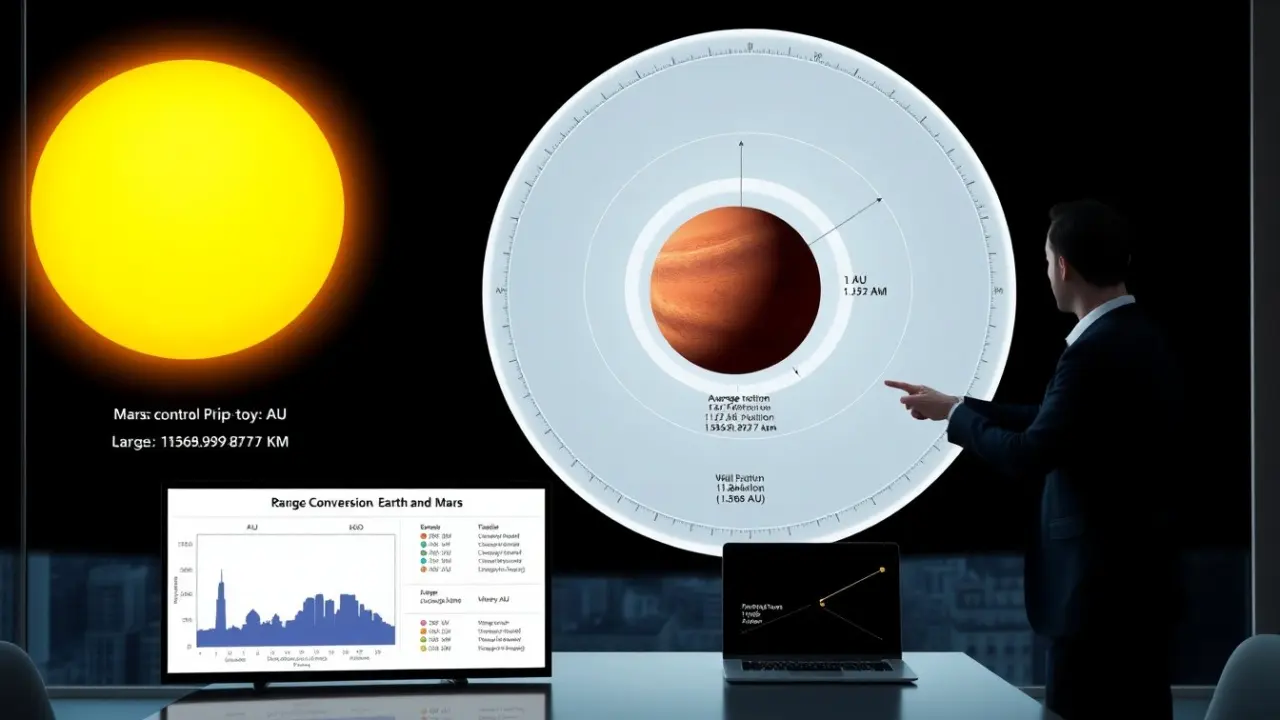
How far is Mars from the Sun in AU on average? Mars sits at about 1.52 AU from the Sun. Astronomers state the value as 1.523679 AU for higher precision. The planet’s average orbital distance equals roughly one and a half times Earth’s distance. Scientists use this average when they model climate and solar flux at Mars. Mission designers use the average to plan transfer orbits and launch windows. The average hides regular variation caused by orbital eccentricity.
Perihelion and Aphelion: Mars’ Closest and Farthest Points
Mars’ orbit changes its distance from the Sun each year. The closest point, the perihelion, reaches about 1.381 AU. The farthest point, the aphelion, reaches about 1.666 AU. The difference equals roughly 0.285 AU across the orbit. This change alters sunlight and seasonal patterns on Mars. Scientists track perihelion and aphelion when they predict dust storm likelihood. Mission teams consider these points when they schedule launches and science operations.
How Mars’ Orbit Affects Its Distance Over Time
Mars’ orbit changes slowly over decades and centuries. Gravitational pulls from other planets shift the orbit. These shifts alter eccentricity and orbital tilt. The changes modify Mars’ perihelion and aphelion values modestly. Long-term cycles can change climate patterns on Mars. Scientists study orbital cycles to interpret sediment and ice records. Planetary models update the AU-based distances as they refine orbital elements. Observers use updated ephemerides to predict exact distance on a given date.
How Scientists Measure Mars’ Distance in AU
Scientists measure distance using radar, spacecraft tracking, and optical observations. Radar sends a signal to Mars and times the return. Spacecraft send and receive signals that yield precise ranges. Optical astrometry measures position against background stars. Teams convert these measurements into orbital elements. They compute Mars’ distance from the Sun in AU using Keplerian models and numerical integration. Agencies publish the results as ephemerides with AU values for any date.
Why Mars’ Distance Matters for Planetary Science and Spaceflight
Mars’ distance affects sunlight, temperature, and atmosphere. Scientists use distance to estimate solar flux and surface energy balance. Engineers use distance to design power systems for landers and rovers. Flight planners use distance to choose transfer orbits and fuel budgets. Mission teams plan communication windows using light-minute delays. Planetary scientists relate distance to seasonal cycles and climate records. Public outreach uses AU values to explain mission timelines and costs in simple terms. Knowing how far is Mars from the Sun in AU helps many practical decisions.