| Solar layer | Temperature | Planning use |
|---|---|---|
| Core | about 15 million °C (27 million °F) | Use it to explain fusion and where the Sun’s energy comes from, not what a planet or spacecraft experiences. |
| Radiative zone | falls rapidly to about 2 million °C (4 million °F) | Use it to show that temperature drops as you move outward from the core. |
| Photosphere (visible surface) | about 5,500 °C (10,000 °F) | Use it as the default answer when someone asks about the Sun’s surface. |
| Chromosphere | about 6,000–20,000 °C (11,100–36,600 °F) | Use it to show that temperature climbs again just above the surface. |
| Corona | up to about 2 million °C (3.5 million °F) | Quote it as a regional maximum, never as the Sun’s single temperature. |
Core, photosphere and corona values come from NASA’s Sun facts page, while the radiative zone and chromosphere ranges come from a Study.com lesson on the Sun’s layers.
How hot is the Sun depends on the layer you mean: the visible surface is much cooler than the core, and the corona above it is far hotter than that surface. Pick the layer first, then the number.
These layer temperatures also set the context for habitability questions such as is mars habitable, which the Mars Habitability Science hub works through in depth.
Choosing the right temperature for the job
A single “temperature of the Sun” does not exist, so the useful habit is to match the figure to the question. Mixing layers, such as setting a core value beside a corona value, produces comparisons that mislead.
- Quoting the Sun’s “surface”: use the photosphere, which NASA gives as about 5,500 °C (10,000 °F). This is the layer you see when you look at the Sun’s disk, and UCAR’s science education pages note that its name means “sphere of light”.
- Explaining why the Sun shines: use the core figure of about 15 million °C (27 million °F). NASA describes this as hot enough to sustain nuclear fusion, so it answers an energy question rather than a surface question.
- Describing sunspots: treat them as cooler patches of the photosphere. UCAR reports temperatures as low as 3,000 °C (5,400 °F) in these regions, so “about 5,500 °C” is an average-style surface figure, not a value true everywhere on the visible disk.
- Describing the outer atmosphere: use the corona’s “up to” figure of about 2 million °C (3.5 million °F). UCAR describes regions with temperatures as hot as that, which is why the phrasing should stay regional.
- Writing for mixed audiences: give Celsius and Fahrenheit together and keep both values from the same source, so the pair stays consistent.
The most important correction is to the intuition that closer to the core means hotter. The outer atmosphere breaks that pattern, as the corona section below shows.
What the temperatures mean for life and habitability
NASA states plainly that nothing could live on the Sun, but its energy is vital for most life on Earth. That is the practical lens for habitability work: the Sun is an energy source to be measured, not an environment to compare with a planetary surface.
The same NASA page calls the 10,000 °F (5,500 °C) photosphere “relatively cool”, which is a useful reminder that the visible surface is the mild end of a hot star. The extreme values sit deeper inside, and above the surface.
Energy also takes a long route out. The Natural History Museum’s Sun fact file says energy from the core takes up to a million years to reach the outer layer known as the convective zone. The Sun’s steady output therefore reflects processes deep inside it, not only the temperature of the layer we see.
Once that energy leaves the Sun and arrives at a planet, the next practical question is how light behaves in an atmosphere. How Fast Is Light In Air? The Practical Guide To Light Speed In Earth’s Atmosphere (2026) – Decolonizemars covers that side of the story.
Layer by layer: from core to chromosphere
Core: where fusion happens
NASA and the Natural History Museum agree that the core is the hottest part of the Sun. It is hot enough to sustain nuclear fusion, in which hydrogen atoms fuse into larger helium atoms, which is the process that releases the Sun’s energy. For any question about why the Sun keeps shining, this is the layer to cite.
Radiative zone: temperature falls outward
Moving outward from the core, the temperature does not hold steady. Study.com’s layer lesson reports that it decreases rapidly to around 4 million °F (2 million °C). This is the layer to cite when you want to show that the Sun cools steadily away from its center, up to the point where the pattern reverses.
Photosphere: the visible surface
The photosphere is what most people mean by the Sun’s surface. UCAR’s temperature figure for it matches NASA’s, and UCAR stresses that it is much cooler than the Sun’s core. Because it is a visible layer rather than a solid ground, “surface” here is a convention for the layer that emits the light we see.
Chromosphere: warmer again
Above the photosphere the trend turns around. The chromosphere runs at about 6,000–20,000 °C (11,100–36,600 °F), slightly higher than the layer beneath it. For anyone building a temperature profile, this is the first sign that the outer layers do not follow a simple cooling-with-distance rule.
The corona and the heating puzzle
How hot the corona gets
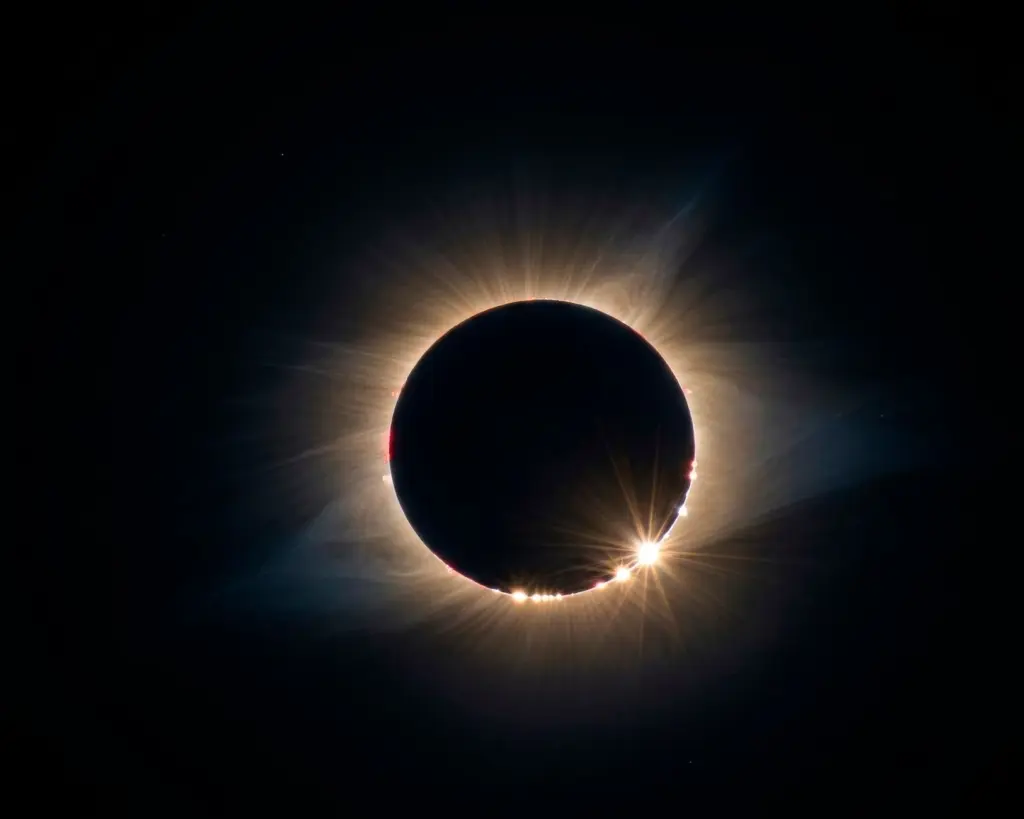
The corona is the Sun’s outer atmosphere. NASA says it gets hotter the farther it stretches from the surface. UCAR makes the contrast explicit: the photosphere is much cooler than the atmosphere above it, which has regions of extreme heat. Wording matters here, because “up to” and “regions” mark the quoted temperatures as upper values, not a uniform temperature.
Why the corona is hotter than the surface
The observation is solid: the corona is far hotter than the photosphere it sits above, and NASA reports it getting hotter with distance from the surface. The cause is a puzzle that, according to Astrobackyard’s overview of solar temperatures, Parker Solar Probe and ESA’s Solar Orbiter are helping to solve. Treat any one-line explanation of coronal heating with caution, and describe the temperature difference as an observed fact with an open question behind it.
Parker Solar Probe and Solar Orbiter
NASA notes that several spacecraft are currently investigating the Sun, including Parker Solar Probe. The Natural History Museum adds that Solar Orbiter will orbit very close to the Sun’s surface. Both missions fly closer to the Sun than earlier spacecraft, so their measurements target the very region where the corona’s temperature behavior is still being explained. Expect their results, rather than eclipse photographs, to refine the coronal story.
Frequently asked questions
Why do some pages say 9,900 °F and others 10,000 °F for the Sun’s surface?
Both describe the same photosphere at about 5,500 °C. NASA gives 10,000 °F, while UCAR gives 9,900 °F, so the two Fahrenheit values differ only in how the conversion is stated.
How thick is the Sun’s visible surface?
UCAR describes the photosphere as only about 500 km (300 miles) wide, a much thinner layer than the interior regions of the Sun.
What is the Sun made of, and why does that matter for its temperature?
The Natural History Museum says the Sun is a ball of gas and plasma, around 91% of it hydrogen gas. That hydrogen is the fuel fused into helium in the core, where NASA says the temperature is high enough to sustain fusion.
Does temperature always fall as you move away from the Sun’s center?
No. It falls from the core through the photosphere, then rises again in the chromosphere and corona, where NASA reports values up to 2 million °C.