Many people picture Saturn alone, but how many planets in our solar system have rings? Four: Jupiter, Saturn, Uranus and Neptune, and the others have much fainter rings than Saturn.
Mars sits outside that ringed group. The hub on can humans live on mars covers what matters for settlement instead. The sections below correct the most common misunderstandings about rings and explain what each ringed planet actually has.
Four ringed planets, not just Saturn
All four of the giant planets have rings, as the Planetary Society’s overview of ring systems states. The belief that Saturn is the only ringed planet has a simple cause. Saturn’s rings were recognised long before the others, while the rings of the other gas giants were not found until the 1970s, according to Caltech’s Cool Cosmos. The rings around Jupiter, Uranus and Neptune are much smaller, darker and fainter than Saturn’s, so they do not show up in everyday pictures.
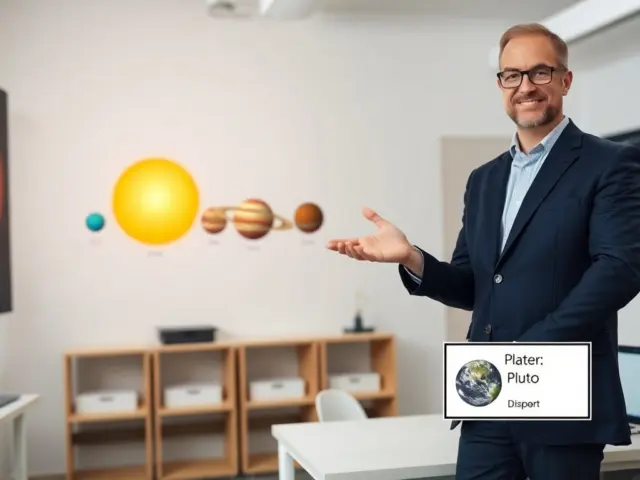
In a line-up of the planets, the ringed worlds are the four outer giants. Only Saturn’s rings are large enough to draw the eye at this scale.
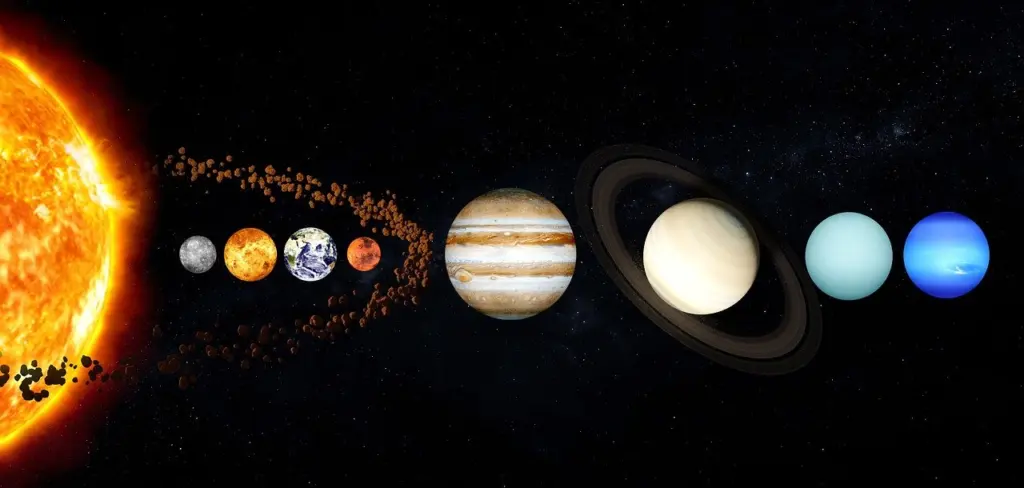
The table contrasts the four systems, because a ring system can differ greatly in brightness, extent and structure.
| Planet | Ring character | Key figures |
|---|---|---|
| Saturn | Bright and broad; mostly water ice and rock | Spans roughly 413,000 km from the D ring out to the end of the E ring; main rings measure just 10 meters tall in some spots |
| Jupiter | Much smaller, darker and fainter than Saturn’s | Spans about 122,000 km; thickness runs from about 100 km in the main ring to 10,000 km in the halo ring; four main sections |
| Uranus | Made from some of the darkest materials in the Solar System | Spans more than 57,000 km; 13 known rings, ten narrow and three broad and diffuse |
| Neptune | Much smaller, darker and fainter than Saturn’s | Five main rings: Galle, Le Verrier, Lassell, Arago and Adams, in order from the planet |
Figures are from the Planetary Society, with the brightness comparison from Cool Cosmos.
Read the table as four different kinds of structure rather than four copies of Saturn. Saturn is defined by scale and brightness, and Jupiter by a thick, faint halo. Uranus has many narrow dark bands, and Neptune has five named rings.
Faint does not mean missing
A second misunderstanding is that dim rings are somehow less real. Across the giant planets, rings are made of rock, ice and dust particles that range from microscopically small to the size of a house, according to the University of Colorado’s LASP outer planets pages. What differs is how well the particles reflect light, and how many of them there are.
Jupiter
Voyager 1 confirmed Jupiter’s rings during its 1979 flyby of the planet, as the Planetary Society notes. The faintness has a physical reason: Penn State’s astronomy course material explains that the particles in Jupiter’s ring are smaller than those in Saturn’s rings and do not reflect light as well.
Uranus
Our only up-close view of the rings of Uranus came from Voyager 2, which passed the planet in 1986. The particles are so dark that, according to LASP, they reflect as little light as charcoal. Dark material is the reason these rings were hard to detect, and brightness is a poor test of whether a ring exists.
Neptune
Neptune hinted that it might have rings during a stellar occultation in 1984. Proof came in 1989, when Voyager 2 captured definitive images of the rings. That sequence shows how a faint system can be suspected from indirect evidence years before a spacecraft confirms it.
Saturn’s rings: thin, icy and young
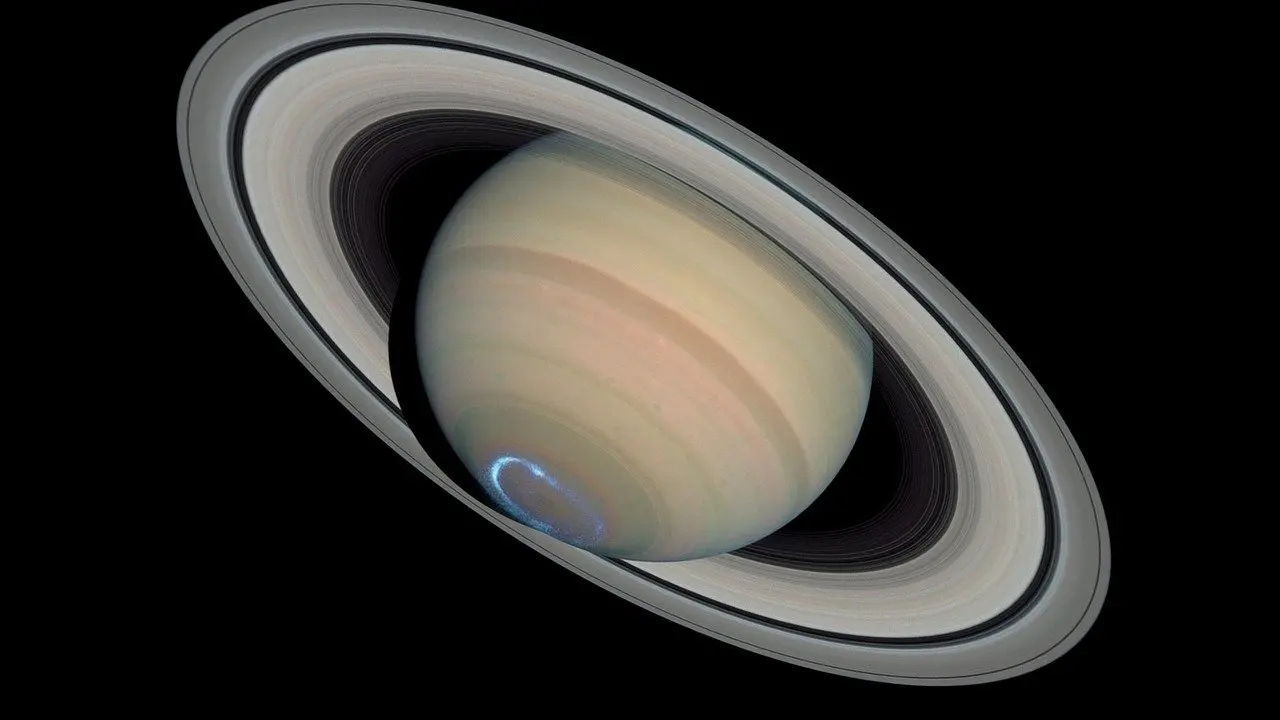
Saturn’s rings are mostly water ice and rock, per the Planetary Society. They are not solid sheets. They are swarms of separate particles, and the ranges quoted for ring particle sizes run from microscopic grains to house-sized chunks. For their enormous breadth, the main rings are exceedingly thin, which is why a near edge-on view reduces them to a line.
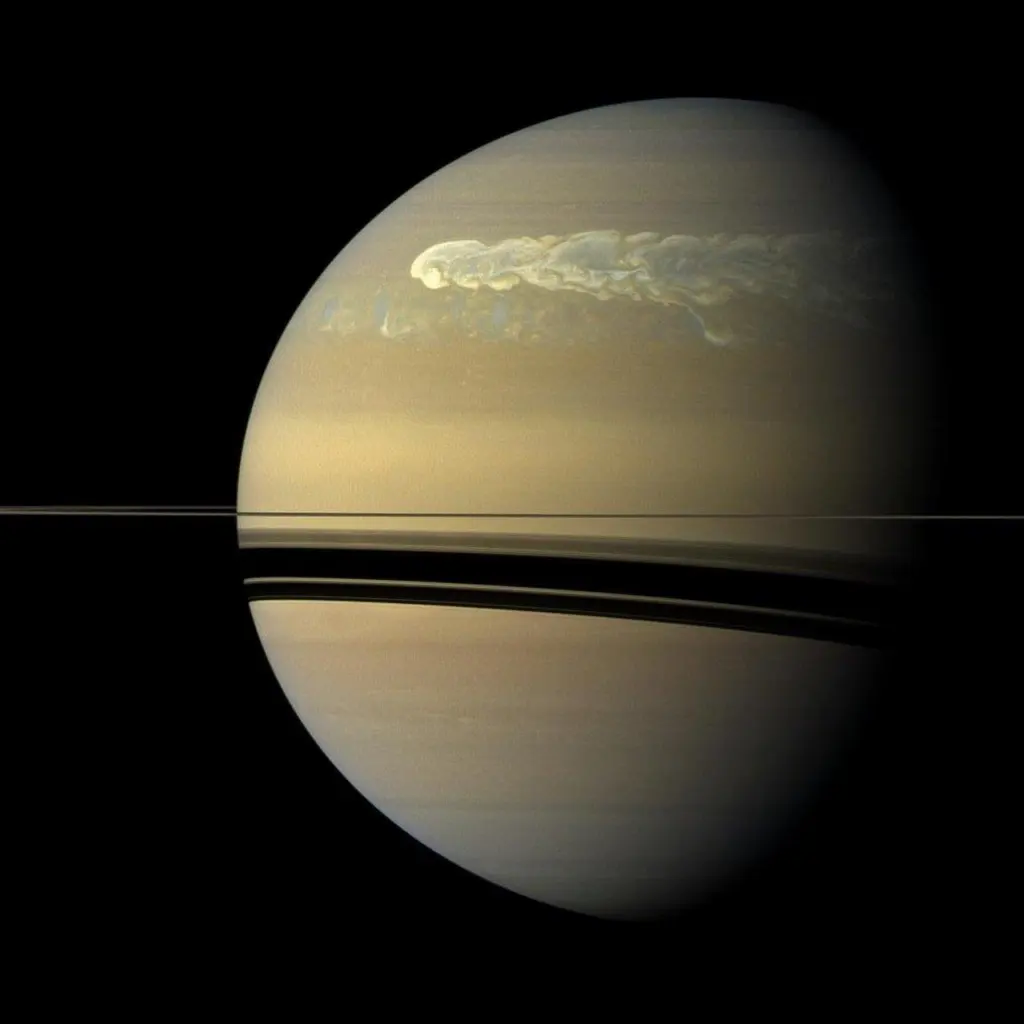
A third misunderstanding is that the rings are as old as the planet. Data from the Cassini mission showed that the rings are relatively young, perhaps 10 to 100 million years old, according to the Planetary Society. Anyone quoting an age for Saturn’s rings should present it as an estimate with that range, not a fixed date.
Why planets have rings, and why only four
Planets have rings because rock, ice and dust particles stay in orbit around them as a flattened band. Beyond that basic description, several points are worth separating.
- The material is shared. The LASP pages describe ring particles on the giant planets as rock, ice and dust, so the difference between Saturn and its neighbours is quantity and reflectivity, not a different recipe.
- Rings may not be permanent. Penn State’s course material says the ring systems of the giant planets may be relatively young, only a few hundred million years old, compared with about 5 billion years for the planets. The Planetary Society says Jupiter’s ring material is replenished, which gives the rings an age of less than 1 million years.
- The outer-planet pattern is clear, but its cause is not settled. BBC Science Focus points out that the large, gaseous outer planets all have ring systems, whereas the small, rocky inner planets do not. The gas giants formed only in the outer Solar System, and the origin of their rings is still uncertain. Treat any single tidy explanation for ring formation with caution.
Where Mars fits
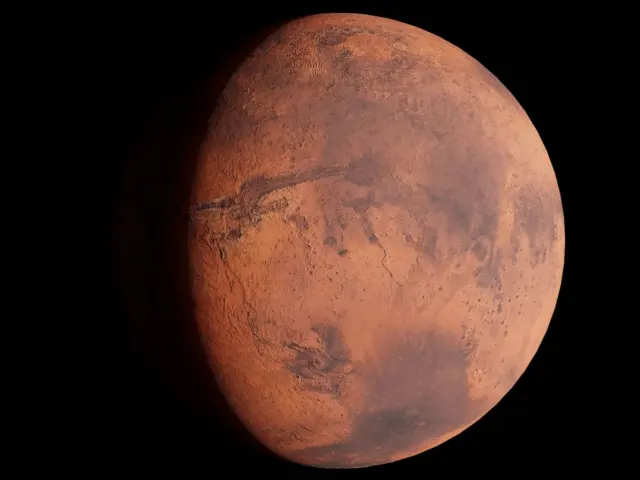
Mars is one of the small rocky inner planets, and that group has no ring systems. The reason the red planet matters to this site is its surface and air, not any ring. If you want the composition of its air, see what is the atmosphere of mars made of. For the people who made spaceflight possible, read Most Famous Astronauts: From First Flight To Modern Space Heroes (Who Made History And Why) – Decolonizemars.
Frequently asked questions
| Question | Answer |
|---|---|
| Who first recognised Saturn’s rings? | Saturn’s rings were bright enough to be seen through Galileo Galilei’s telescope in 1610. It was not until 1659 that Christiaan Huygens correctly deduced that they form a ring system encircling the planet, as the Planetary Society recounts. |
| How long did Cassini study Saturn’s rings? | From 2004 to 2017, a period the Planetary Society describes as revolutionizing knowledge of Saturn and ringed planets in general. |
| How were the rings of Uranus discovered? | Scientists discovered them in 1977 using NASA’s Kuiper Airborne Observatory, through a stellar occultation, according to the Planetary Society. |
| Do the rings of Uranus look like Saturn’s in images? | No. Penn State’s course material notes that Uranus’s rings appear vertical, while Saturn’s are horizontal. |